
For more than a year, I have been building a personal second brain.
When I began, I thought the problem required heavy machinery. I studied enterprise ontologies, drew knowledge graphs, wrote hundreds of unit tests, and built standalone prototypes. Yet after a long detour, the system I eventually open-sourced as SecondBrain-Lab rests on something much simpler: local Markdown files, a short AGENTS.md file in each folder, and Wikipedia-style articles.
Almost every time I added a clever layer to the system, a few weeks of real use forced me to take it back out.
Starting with SECI and Aiden
The project started with a simple observation: talking to AI every day pushes tacit knowledge out of your head.
In knowledge management, Nonaka’s SECI model describes knowledge conversion as a slow spiral — tacit experience turns into explicit text, gets combined, and is eventually internalized again. In the past, writing things down was always the expensive step, because most people hate writing documentation. Once you spend hours every day explaining context to a model, correcting its misunderstandings, and spelling out why an approach will not work, that barrier drops dramatically. Ordinary conversations begin producing real, explicit raw material.
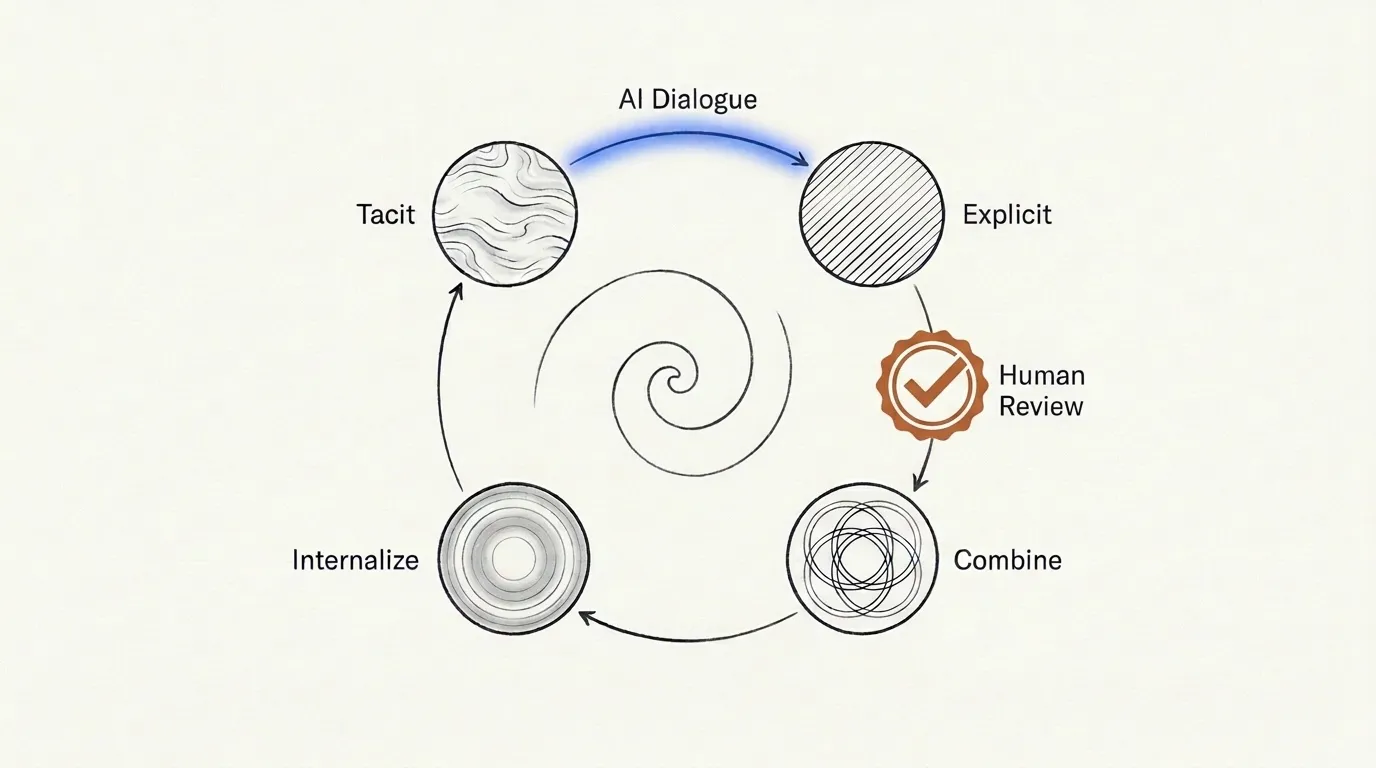
Following that observation, I built my first prototype, Aiden, in the summer of 2025. At first I wanted a restrained thinking companion, guided by a simple rule: doing one core feature well is worth far more than adding a hundred mediocre ones. Soon, though, I became absorbed in knowledge combination. I tried building an AI-era Zettelkasten on top of SECI — breaking notes into atomic cards and letting AI collide cards with each other to spark new ideas. I believed AI would be much better than humans at cross-card combination.
I eventually stopped pushing that direction for two practical reasons. First, combination depends on clear concepts upstream; when definitions and boundaries are still blurry, colliding vague cards mostly multiplies noise. Second, reliable input cards do not guarantee a reliable combined output. AI is very good at producing plausible-sounding synthesis, yet without a real task and a negative feedback loop to test whether a combination holds up, the library fills with unverified cleverness.
That experiment was still useful. It pushed my attention one step earlier in the chain: the main reader of notes was shifting from humans to AI, and the human’s job was shifting from writing every document from scratch to acting like a committer — making sure what enters the main library is clear and sound, reviewing, trimming, and deciding what deserves to be merged.
What Counts as Knowledge, and What Counts as Memory
Stepping back from Aiden forced me to face two basic questions I had been skipping over: what is knowledge, and what is memory?
On knowledge, my earliest pass in Aiden borrowed from Aristotle’s logic of causes, splitting notes into three kinds of atoms: Pattern (structure), Component (concrete material), and Method (how-to rules). That helped for a while, before I stepped back further to the classic DIKW hierarchy (Data, Information, Knowledge, Wisdom).
What stayed with me from DIKW is the idea of a ladder of abstraction. Each layer compresses the one below it, and upward compression is always lossy. For today’s agents, context windows are tight; an agent cannot swallow every raw transcript on every run. Yet if the index and hierarchy are laid out cleanly, the agent can land quickly on the compressed upper layers (L3 through L5), and whenever a task calls for exact evidence, it can decide on its own via tool calls to drill back down into the full original text (L1 and L2). Done right, you stay within a small context window while getting close to lossless recall on demand.
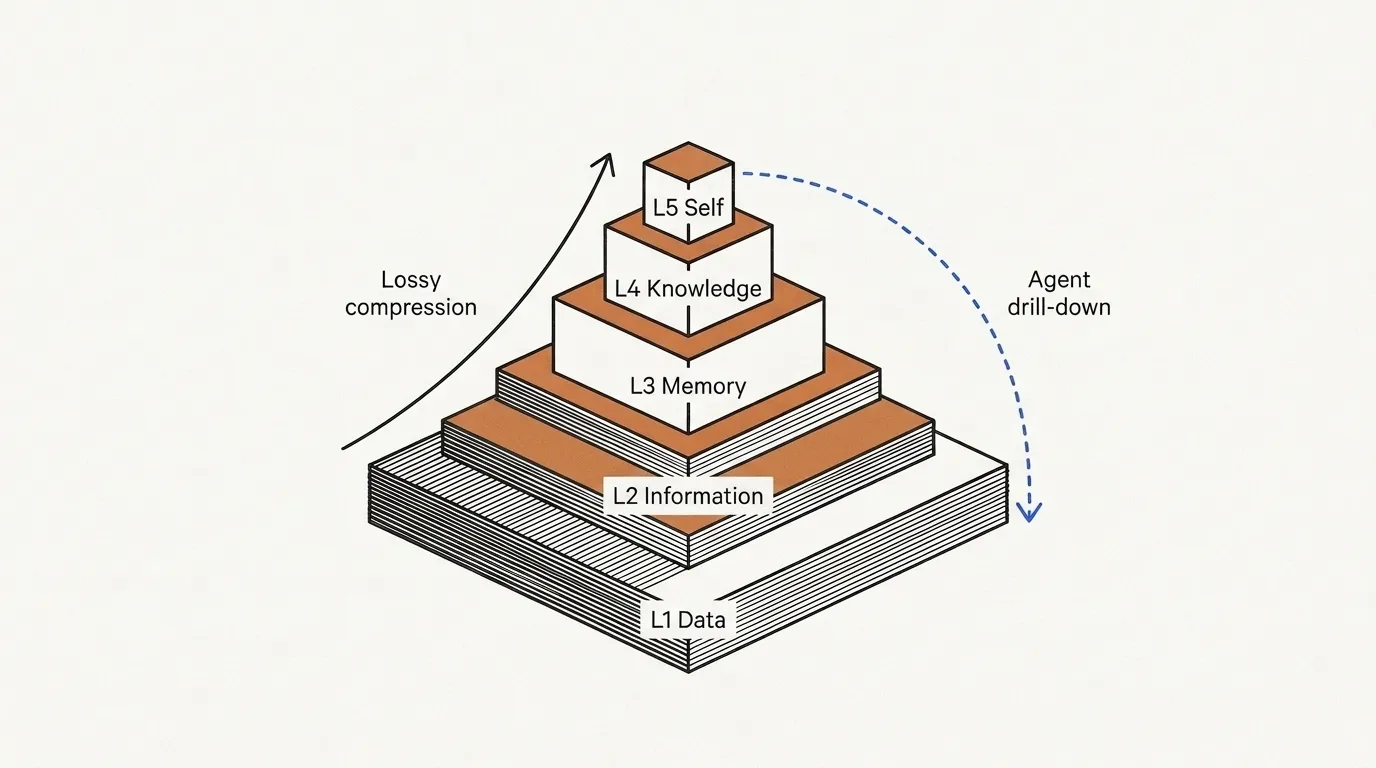
Next came memory. I read through both cognitive science and engineering approaches: academics usually split memory into episodic (what happened), factual or semantic (what is known), and procedural (how to do things), while another camp in AI engineering prefers simple chronological daily logs. I spent months mapping those distinctions — L1 Data, L2 Information, L3 Memory, L4 Knowledge, and L5 Self — onto actual folders.
The folders grew cleaner and cleaner, yet they only solved where things go in and how to find them. By themselves, neat folders still did nothing to stop memory from decaying over time.
Ontology, Palantir, and Knowledge Graphs
What led me down a detour next was how knowledge should be stored.
Around that time, I spent weeks studying Palantir. Many people think of Palantir’s Ontology as a more sophisticated knowledge graph, but if you look closely at real deployments, the real difference is whether it includes actions. A read-only knowledge graph answers how A relates to B. Palantir’s Ontology sits between data and daily operations as a live map that attaches actions, preconditions, and approval gates to business objects — agents read the current state and propose an action, and humans approve writing it back. At bottom, it is a shared interface specification across systems.
I liked the idea enough that I tried organizing my local folders the same way, separating concepts, rules, skills, and artifacts. It did not take long to feel the friction.
A system’s structure has to match the nature of its data. If you are running a structured, real-time, auditable operation — like aerospace manufacturing or a supply chain — defining nouns, actions, and permissions first and attaching LLMs afterward makes sense. A personal second brain is the opposite: it is open-ended, unstructured, and constantly growing new topics and half-formed ideas. Putting a heavy ontology and a graph database in front of a few hundred personal notes means maintaining an extra query language and a background service, when grep already covers almost everything you need at that scale.
That detour gave me a clear boundary: in a personal system, a lightweight ontology is enough. Folders represent domains, a type field represents the class, Markdown links represent relations, and frontmatter holds attributes. The rest of the understanding can be left to the model on demand, without building a huge schema up front.
Back to Files and Signposts
Once I removed graph databases and heavy modeling, the system naturally settled back on the 1969 Unix principle: everything is a file.
For a knowledge base, plain text is an LLM’s native format. Storing knowledge as Markdown files lets humans, language models, and Bash tools like grep, cat, and sed share the same interface. There is no ORM, no extra serialization layer, and no fear of being locked into a proprietary tool. Git version history and plain file backups come free with text files.
Each file has two parts. At the top is a small, fixed YAML frontmatter block (type, status, source, date, and a few relation fields) that scripts and command-line tools can filter and validate deterministically. Below it is an unstructured Markdown body that preserves background, conditions, and exceptions for both humans and LLMs. Those Markdown files remain the single source of truth; SQLite indices, full-text search, or visual graph views are disposable caches that can always be deleted and rebuilt.
As files accumulated, the next problem was how an agent should find what it needs. Loading the whole directory into context quickly overflows the window, while adding vector search brings opaque chunking and extra maintenance. I ended up using a much simpler method: folder signposts.
The root AGENTS.md contains only a short resident note telling the agent when to consult the library and forbidding it from loading everything at once. Each subfolder has its own AGENTS.md or index page that describes what lives there without holding the actual content. Once an agent learns to navigate one level of directories, it can walk deeper levels the same way, so the amount loaded into context no longer grows with the total size of the library.
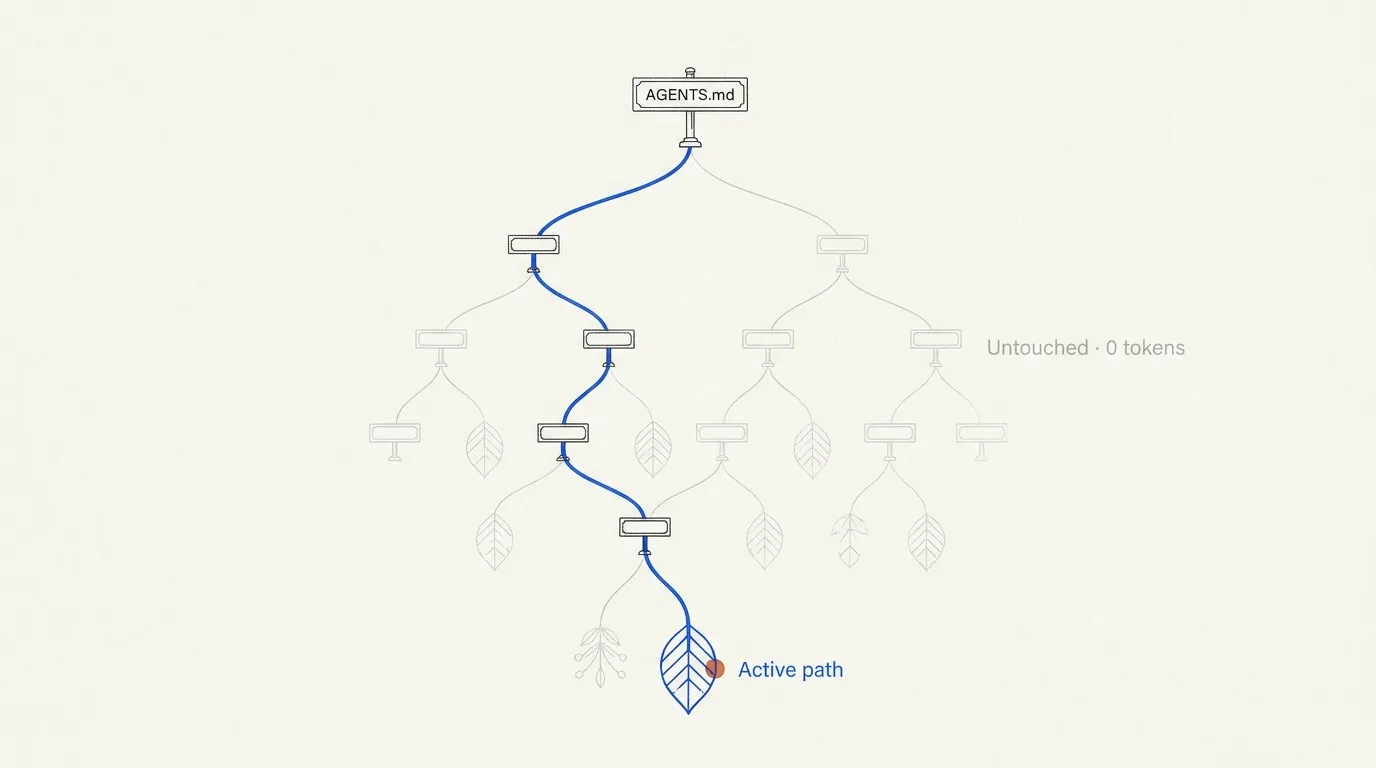
At a personal scale of a few thousand to tens of thousands of lines, letting a model follow folder indices and grep is usually more accurate than relying on vector similarity alone, because the model searches with a specific purpose. The approach does have limits: when you cannot recall the exact term, when notes mix Chinese and English synonyms, or when the library grows large enough that directory hops take too many turns, full-text and semantic indices still earn their place as rebuildable helpers.
Two older engineering ideas kept this simple design from drifting. From Unix, I borrowed breaking the work into small, independent steps — filing, extraction, diffing, recall — connected through plain files and clear conventions, decoupled from any specific UI or model. Even if you replace the frontend, the external agent, or the scheduler, the knowledge rules still hold. From Fred Brooks’s The Mythical Man-Month, I borrowed conceptual integrity. What ruins a small system is rarely bad code; it is the steady accumulation of new features that each sound reasonable on their own. Over the year, I cut the graph database, the built-in small model, and a custom sync service I had planned to write. Every cut made the system easier to use.
660 Notes, Only 8 Deprecated
That file structure ran for a while until one day I checked the entire library carefully and saw the real problem.
The numbers were discouraging. The library had grown to roughly 660 knowledge cards, yet only 8 were marked deprecated, only 7 carried a supersedes link, and zero tracked whether a note had ever been used afterward.
The reason was straightforward: I had required every formal change to go through a proposal and human review, which made deleting an old record just as tedious as adding a new one. Whenever I had spare time, I preferred capturing something new over retiring old cards, so the library turned into a one-way warehouse. Worse, hundreds of date-sliced cards broke a single topic into scattered fragments. In one version, my kernel passed 586 unit tests, yet five source documents produced four overly cautious “audit memos” — and I adopted none of them. Every test was green, and the system was still unpleasant to use.
Knowledge decay is an ongoing process; you cannot eliminate it, only manage it. Records of what happened do not expire — “we chose Option B last October” remains true forever, even if it stops mattering later. What expires are claims about what is still true today. Humans glance at an old date and discount it automatically; agents follow outdated rules without hesitation. Calendar-based reviews rarely last because they demand too much attention, so verification has to be tied to actual use. There is still a blind spot here that I have not fully solved: if an agent follows a stale rule without raising an error, it will not flag the rule itself. Revisions still tend to happen only when a human notices a mistake downstream, or when new material contradicts an old record.
What finally broke the stalemate was dropping isolated cards in favor of Wikipedia-style articles. Wikipedia holds off decay because readers are also editors, flagging a problem is separated from rewriting the text, undo is cheap, and protection is tiered by importance. Applied to a personal second brain, the rule is simple: one object gets one continuous article. I started creating articles by project, person, and concept, dividing them into sections by aspect, keeping a dedicated “Evolution” section to record how views changed over time, and adding an object map to track renames, merges, and relationships.
That shift also eased the cost of deletion. Correcting an outdated view used to mean tracking down a dozen scattered cards and deprecating each one; with living articles, you edit the relevant paragraph directly and record the old view under Evolution. I reorganized the existing material into twenty-odd objects and a couple hundred articles. For the first time in over a year, I actually wanted to open my own library and read through it.
Three Principles That Survived
Those detours eventually became SecondBrain-Lab. Strip away the specific stack and interface, and only three principles really held up.
Do not bundle a weak model inside the app when you can borrow the strongest reasoning engine you already use. Early on, I built a cheap extraction model into the tool, and then had to write longer and longer rules and prompts to keep it from making mistakes until the whole pipeline became heavy and brittle. Removing the built-in model fixed it. The tool now exposes a clean interface so whatever strong agent you already use each day can come in periodically to process new material and tidy old articles. Models turn over every few months; decoupling the storage layer from any single model keeps the system from going stale with last quarter’s weights.
Separate writing, checking, and approving. Agents can only submit proposed edits to a review queue; they cannot overwrite the main library directly. Mechanical, deterministic checks belong in code: verifying line by line that quoted footnotes match the original text, that untouched sections remain intact, that “X believes…” actually cites X’s own words, and that no sensitive information leaked. Once code handles those checks, the human in the review interface only needs to judge two things: whether the meaning is accurate, and whether it is worth keeping. Human review is still a bottleneck — if new material arrives faster than you review it, the queue still backs up — so flagging and archiving need to be one-click actions, leaving full review for edits that actually enter the main articles.
Always keep the original files, and use an “amnesia test” to restrain the urge to summarize. Every summary is lossy compression, and it often drops the exact detail you end up needing six months later; long-term recall depends heavily on keeping the raw records intact and directly searchable. As for whether a paragraph deserves to go into an article, I now ask one question: if an agent starting fresh tomorrow with no memory of our past chats needs to help me with real work, does it actually need to read this paragraph? If not, leave it out.
After more than a year of building a second brain, I realized the hardest part was never storing information or retrieving it. It was figuring out what is worth keeping, and being willing to delete the rest.